I believe a traditional kung fu school gives you the most complete martial arts experience you can find.
Let me be clear about what I'm not saying. I'm not saying kung fu is the best martial art. When it comes to the martial arts, I think it depends on the individual, how much effort they put into their training, and whether they actually pressure test what they do.
What I mean by complete is everything you can experience and get to do at a traditional kung fu school. Here's what that looks like.
Fighting
First and foremost, kung fu (功夫, gung fu) is a martial art. Chinese martial arts have always been fighting arts, so a real kung fu school should have fighting in it. I'm thankful I came up in Shaolin Hung Fut Kung Fu (洪佛派, Hung Fut Pai) at a school that put fighting and real combat first. I was sparring grown men at fourteen, and I wrote about what that did for me in Kung Fu Doesn't Have a Fighting Problem. It Has a Training Problem. If you love to spar, you can get that at a kung fu school.
Forms
Kung fu has some of the most beautiful forms in all of the martial arts. They're connected to deep history and tradition, and they also hold practical techniques you can take into your fighting. And if you don't want to fight, you can focus on the forms by themselves. That's a path too.
Weapons
Nobody walks around with a spear or a sword anymore, I know. But weapons are fun, and they're another way to train and condition your body. They also teach you how to use an everyday object to defend yourself. By my Sifu's generation, our curriculum carried twenty-five weapons forms, from the staff and the spear to the broadsword.
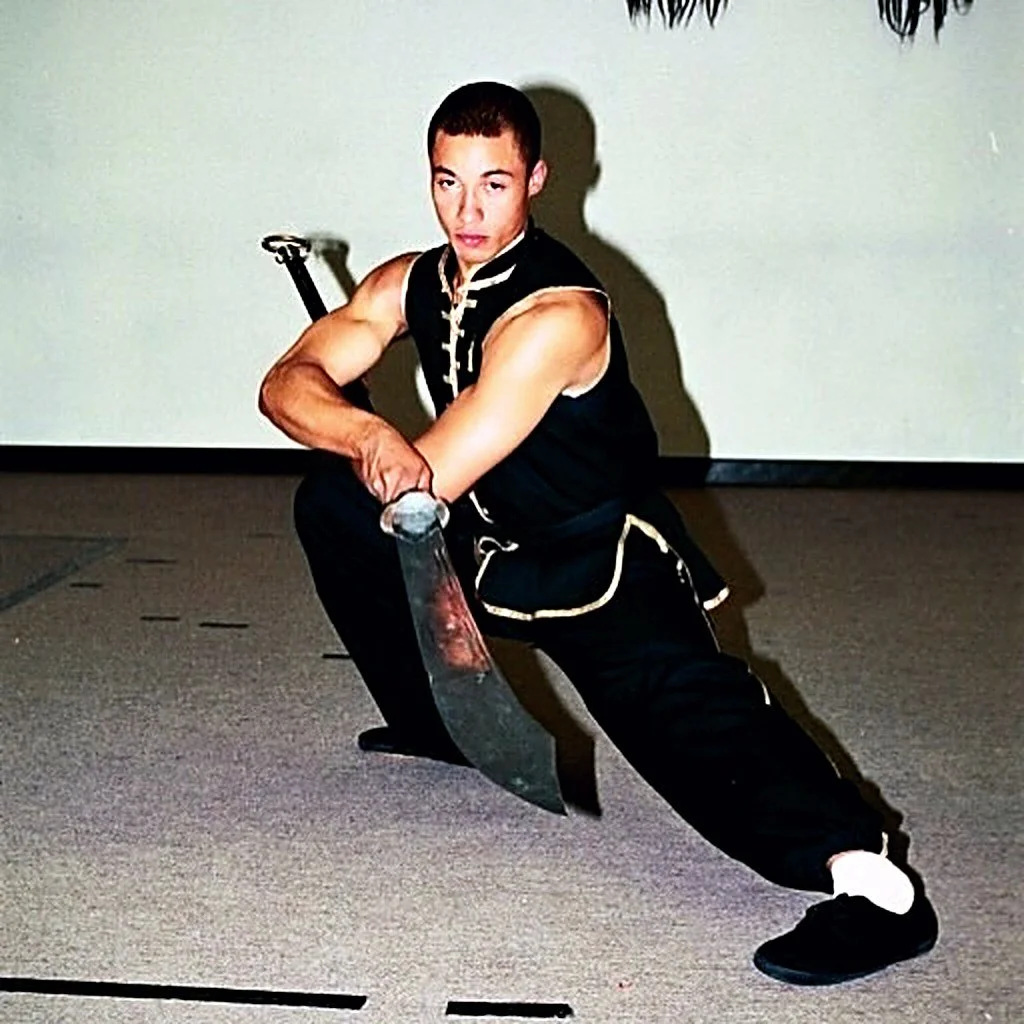
Me with the broadsword.
Conditioning
If you just want a great workout, the basics of traditional kung fu will give you one. Stretching, calisthenics and plyometrics are all built into the training. On top of that, there's the body conditioning that toughens up the arms, hands and body over time.
It all starts with the horse stance. There's an old saying in my lineage, 未學打先學馬 (mei hok da sin hok ma), which means "before you learn to fight, learn your horse." At our school, you had to pass a horse stance test before you were allowed to start weapons.
Culture
When you train kung fu, you're also stepping into a culture. You end up learning some of a second language just to follow your own training. And then there's the traditional Chinese lion dance (舞獅, mo si) and dragon dance (舞龍, mo lung). Performing up and down the East Coast has been one of the best experiences of my life.
Chinese New Year was the best. When our school was still in Wheaton, Maryland, we didn't even have to drive. We'd perform at one restaurant, then run across the street to the next one, and keep going until we'd pretty much toured the whole area. It was so much fun, and it pulled me deeper into kung fu culture, which is really Chinese culture.
Even our lineage is tied to it. Each generation of Shaolin Hung Fut Kung Fu is named after a character in a poem written by our second generation grandmaster. My generation, the ninth, is 英 (ying), which means heroic, and our generation's hall is called Ying Ying Tong (英英堂).
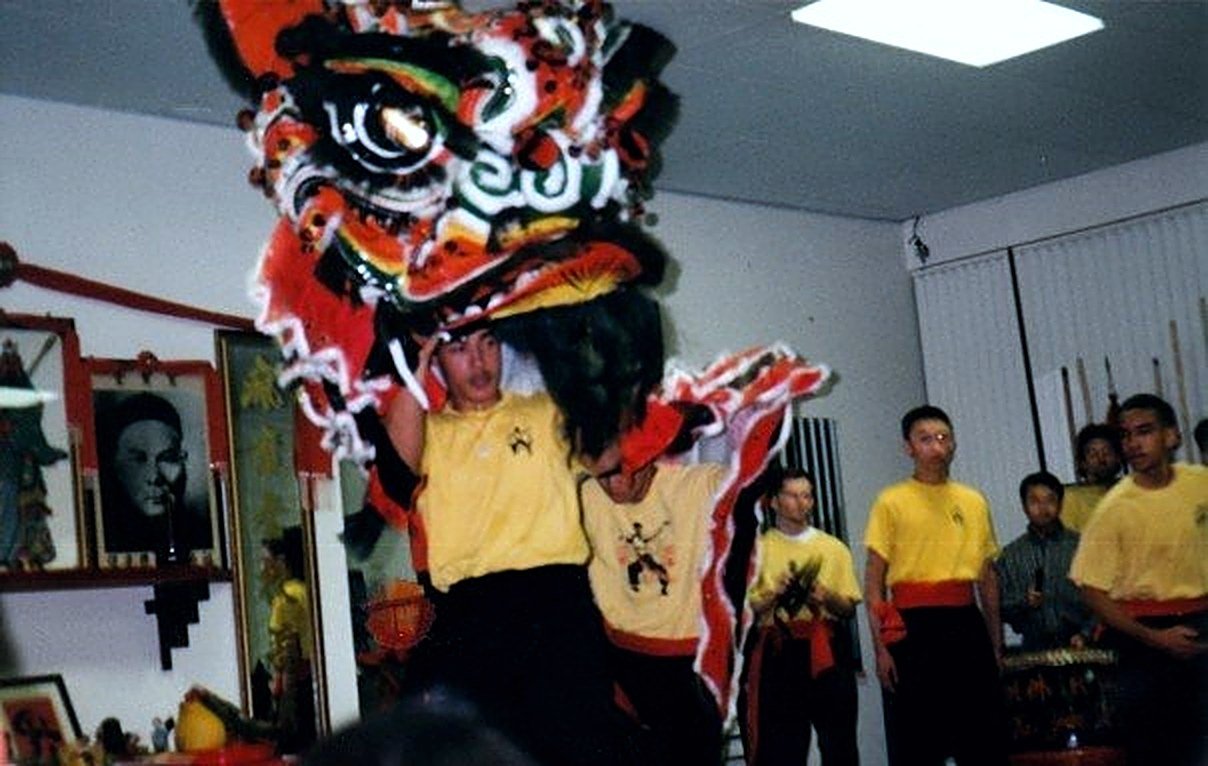
Lion dance with my classmates.
Healing
One of the things my Sifu, Grandmaster Tai Yim (閻泰來, Yim Tai Loi), taught us is that if you want to be able to hurt someone, you also have to know how to heal them. At a traditional school you get exposed to traditional Chinese medicine, like acupressure and the dit da (跌打) formulas used for bruises and injuries, so you can help your own body and the people around you heal and recover.
Choose your path
The amazing thing is that you can experience all of this in one traditional kung fu school. Maybe not all of it is for you. Maybe you just want to fight. Maybe you want to learn flips and perform forms. You can do that. When you're at a traditional kung fu school, you get to choose your path, and you don't have to go to five different places to get it.
Now, that boutique nature might be part of the reason kung fu has lost some of its prominence. When a school offers everything, it can be hard to explain what it is in one sentence. That's a conversation for another day.
But I still believe it. A traditional kung fu school gives you the most complete martial arts experience there is.
Keeping Kung Fu Martial
I put my Sifu's principles and the step-by-step method I use to take a technique from the form to a real fight into a free guide. Get the free Keeping Kung Fu Martial guide here.