Every few weeks somebody asks me if kung fu can work against MMA. I understand why people ask. But I think it's the wrong question, and that's why the argument never goes anywhere.
MMA isn't a style
MMA is a rule set and a way of training. Most of the people competing in it come from two or three different backgrounds, and they spend every week fighting people who are trying to stop them. The results tell them what works and what doesn't.
Kung fu (功夫, gung fu) isn't one thing either. It's hundreds of systems from different regions and different centuries. So "kung fu versus MMA" isn't really a comparison between two styles.
Look at karate. For years people said karate couldn't hold up in the cage. Then Georges St-Pierre, Lyoto Machida and Stephen "Wonderboy" Thompson all came out of karate and did just fine. It never came down to the style. It came down to the person, and whether they were willing to find their gaps and fix them.
Every kung fu movie already gave us the answer
We all know the formula. The hero gets beaten up, or someone in his family gets killed. He goes and finds a master. The master tests his discipline and his perseverance with brutal training and conditioning. Then, finally, he learns the form.
A lot of schools stop right there. But in the movie, that isn't the end. Next, the student fights his own teacher and his classmates, in a safe and controlled setting, until what he learned holds up under pressure. Then he goes and handles business.
And when the villain shows up with an iron body that nobody can break, the hero doesn't quit his art. He goes and finds the master and the method that can beat it. He fixes the hole.
That's the whole job, for us as students and for us as schools. Can I use what I train against somebody who is actually trying to hurt me? If not, find the gap and fix it.
What that looked like for me
I started training Shaolin Hung Fut Kung Fu (洪佛派, Hung Fut Pai) in December of 1995 at my Sifu's school in Wheaton, Maryland. I was fourteen. Our school put fighting first, and the people across from me were grown men.
One of them was my Sihing Brian. A sihing (師兄) is an older brother in the school. Fighting grown men like him as a fourteen-year-old kid really increased my confidence and my courage. By the time I got to high school, I knew I didn't have to be afraid, because nobody there was going to be tougher than the guys I was sparring with at kung fu.
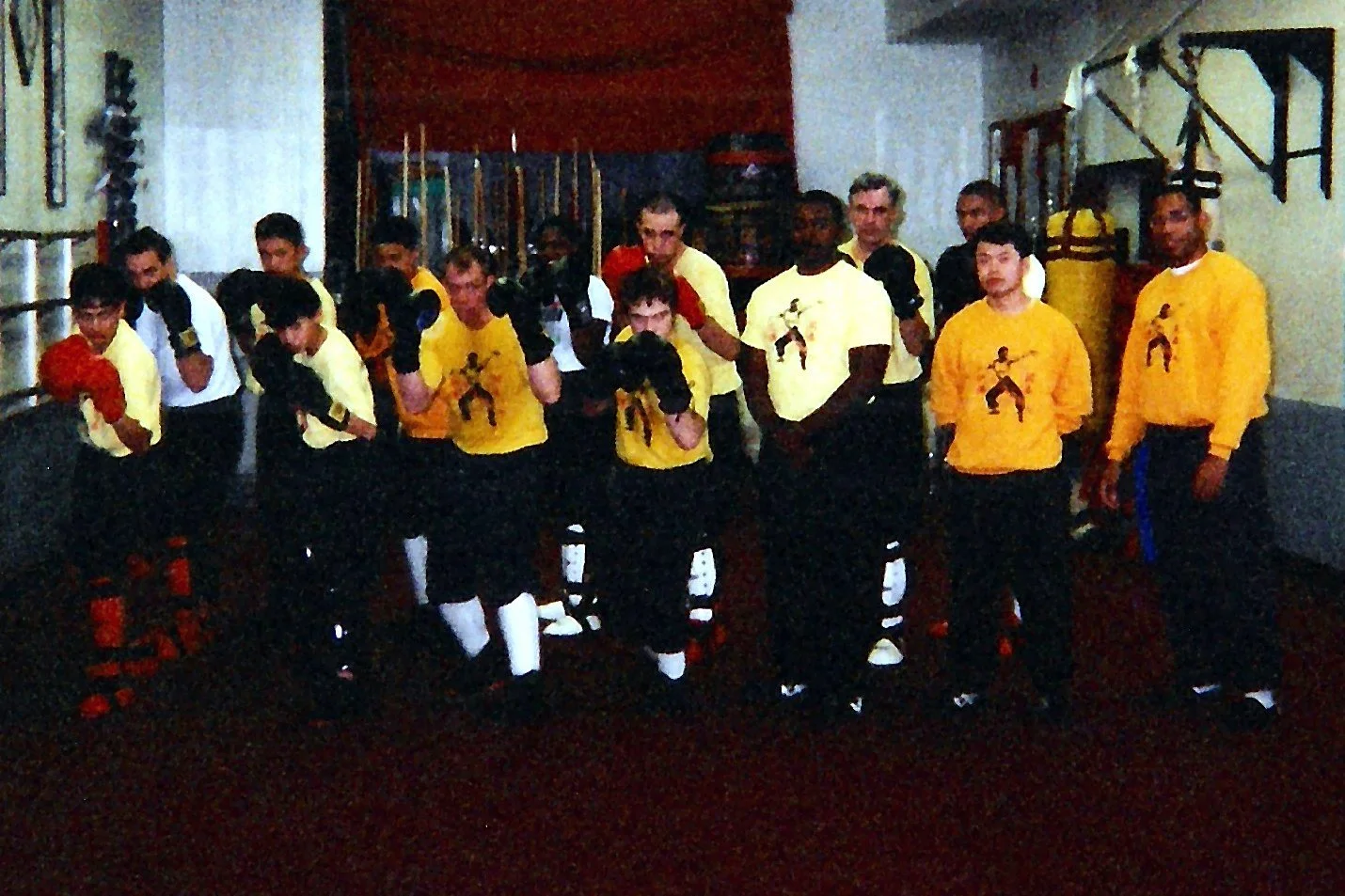
Sparring class at my Sifu’s school when I was coming up.
A form is a long combination
People love to say forms don't teach you how to fight. I agree. Neither does a heavy bag. The bag doesn't move and it doesn't hit back, and nobody has ever called boxing fake because of it.
Walk into any MMA gym and you'll see a coach have his fighter run the same sequence on the mitts over and over. Jab, cross, hook, low kick, until the body owns it. That's prearranged movement, drilled against someone who isn't trying to hurt you. That's a short form. A traditional form is just a long combination that somebody wrote down generations ago and gave a name like Black Tiger Steals the Heart (黑虎偷心, hak fu tau sam).
That combination on the mitts doesn't teach the fighter to fight either. His coach knows that, and that's why the fighter spars. A good kung fu school works exactly the same way. Training forms was never the mistake. The mistake is expecting one tool to do the whole job.
My Sifu, Grandmaster Tai Yim (閻泰來, Yim Tai Loi), wrote about this in his column in Kungfu Magazine back in the summer of 1992:
"Forms are essential to kungfu training, but it is virtually impossible to use a form move by move in an actual fight."
And in the same column:
"To be able to defend yourself in a real situation, you must have actual sparring experience."
We used to do this in public
This isn't a new idea in my lineage. In December of 1975 in Hong Kong, my Sifu and his friend Yip Gwai Tong (葉桂棠), a taekwondo instructor, put their students in a ring together in front of a crowd. It started as a friendly comparison between two schools whose teachers got along. It got heated fast. At a banquet afterward, his friend told Sifu that his students had fought well and said they wanted to do it again the next year. Sifu agreed on the spot.
When Sifu came to America, he kept building places to test. In 1986 he helped found the North American Chinese Martial Arts Federation (北美洲國術總會) and served as its president, running tournaments where kung fu people could find out what actually worked.
What we should copy from combat sports
I'm a ninth generation master of Shaolin Hung Fut Kung Fu and a proud traditional kung fu practitioner, and I'll still say it. We'd be foolish not to learn from MMA, BJJ and Muay Thai. They build resistance and pressure testing into almost every class. They get feedback right away, and their coaches get corrected by results, not by rank. They've been testing what they do in public for thirty years, and most of us haven't.
I'm not telling anybody to drop their system or throw out their forms. I love the mystique of kung fu as much as anyone. But whatever you give most of your time to is what your students are going to get good at. If you actually want them to use the crane (鶴, hok), put the crane into your sparring program. Drill it, work it on pads, spar with it, then test it. Then move on to the next animal.
Here's what that can look like with a single form. Say you're learning a monkey form (猴拳, hau kuen). Keep all of the hand conditioning, the tumbling and the dexterity work. Then take the principles of that form into sparring with your classmates, and then into a tournament, and see what works and what doesn't. That should be part of passing the form. Our styles are robust enough to fit into any rule set.
Sifu put it this way in Kungfu Magazine in the spring of 1993:
"If a technique is good, then it should 'stand up' to the restrictions of fighting within the ring."
The same goes for weapons
The legendary weapons of China are a big part of what drew me into kung fu, and I still think weapons forms have real value. A weapon is an extension of the body. It teaches structure, timing and distance better than almost anything else, and that carries over. Because of my weapons training, I can pick up a stick, a chair or an umbrella and use it better. A parry against a straight attack is still a parry with a chair in my hand.
There's a story about this from my own lineage. Chan Tai-San, a grandmaster from another southern style, wrote about watching our sixth generation grandmaster, Bak Mo Chiu (白毛照), get jumped in a teahouse by men with butterfly knives. Bak Mo Chiu calmly finished his tea, broke two legs off the table and handled them with those. Nobody calls that a weapons form, but that's exactly what weapons training is for.
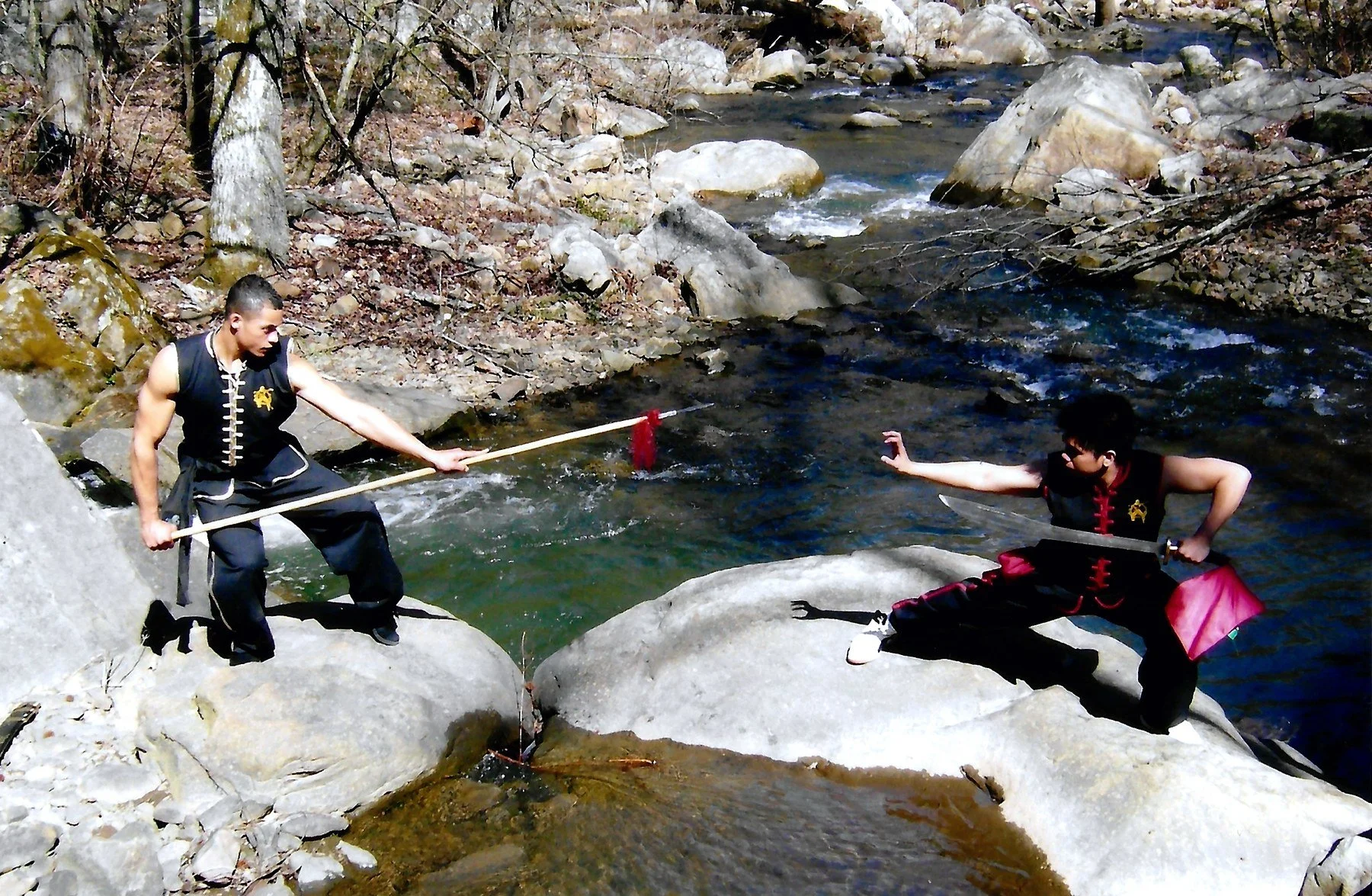
Spear against broadsword.
But most of us have only ever run a weapon set with nobody swinging back. A kendo master or a champion fencer has spent years against live opponents at full speed, with a clear way to tell who hit who. If we're going to keep our weapons, let's train them the way they were meant to be used. Otherwise we're just carrying something heavy and calling it tradition.
One day I'd love to see a kung fu practitioner stand in against a champion fencer or a kendo master, or enter a HEMA tournament with the weapon of their choosing. I believe our weapon systems can hold up. Let's find out.
The forms aren't the problem
Plenty of people tell me they love the art and don't really care about fighting. That's fine, and kung fu has room for you. But the forms really come alive once you understand the application and the intent behind each movement. And if we take the martial out of the art, kung fu turns into Chinese ribbon dancing. I don't think that honors where it came from.
We don't need to defend our styles. They were here before us, and they'll be here after us. Our job is to find out what our training can and can't do, and then make it better.
So let's be honest about our training. Does it make it to the end of the movie, where the hero beats the bad guy? Or does it stop at the training montage?
Keeping Kung Fu Martial
I put my Sifu's principles and the step-by-step method I use to take a technique from the form to a real fight into a free guide. Get the free Keeping Kung Fu Martial guide here.